
So, you’re thinking of remodeling your home, maybe coating your garage floor, patio, basement… or even your driveway. You’re about to wade through the process of choosing from an infinite array of coating products and floor coating systems. This daunting process will allow you to make the decision of whether you would prefer a DIY project or if the task at hand warrants a professional installer. In this post, we will explore the types of floor coating products available.
Before discussing each type of coating, it is important to understand that each coating category comes with a variation of products ranging in quality. Selecting lower grade coatings may result in chemical staining from car tires, discoloration (yellowing) from UV exposure and delamination due to poor adhesion or moisture failure.
There are 3 main types of floor coatings:
- Epoxies
- Polyurethanes
- Polyureas & Polyaspartics
EPOXIES
What do you know about epoxies? There is more to epoxy knowledge than hardware stores lead on. Have no fear we are here to explain them to you. Typically, people automatically go-to the 2-component epoxy from the hardware store, believing that this is their only option. The lack of knowledge of various epoxies could be the reason you will be re-coating your flooring within a year.
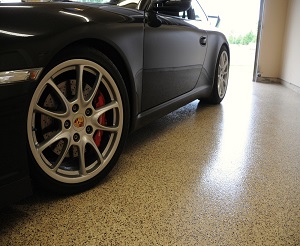
Epoxies function as a problem-solving coating. They take stubborn substrates like concrete and make them usable for the application of multiple coats. It is important to note that multiple coats are needed for the proper installation of coating systems. There are many sub-categories in the epoxy category. The 3 most common epoxy sub categories in garage floor coating applications today are:
- 100% Solids Epoxies
- DIY Epoxies
- Hydro Epoxies
100% Solids Epoxies
Solids Epoxies are 2-component products that can be used as a stand-alone product given the right substrate condition. Typically, they are used as primer coats. This epoxy is referred to as a 100% solid because of the way the product cures. The curing process is a chemical process which is distinctive from processes which commonly use evaporation and water. The mixture of 4 mils (a “mil” is a unit of thickness equal to 1/1000 of an inch) of this product applied to a substrate will form a coating that is 4 mils thick. This allows for the product to be thickly applied burying substrate imperfections and fabricating a lasting durable floor coating. On the down side, this mixture does not last long once it has been mixed. If the mixture is not used in a short period it will no longer be effective (Short Pot Life).
If you choose to use this type of epoxy, note that it is best used by professional installers who can maximize its pot life.
DIY Epoxies
DIY epoxies are designed for non-professional installers. These epoxies have a long pot life which allows the user more time to apply the mixture to their concrete surfaces. These epoxies are a favorite of the DIY crowd and are available at your local hardware store for a relatively low price.
Be advised that albeit with a low percentage solids and a high volatile organic compound are unhealthy.
When a product contains low solids, they are basically a thin film that will not last very long in comparison to industrial epoxies. DIY epoxies tend to chalk, amber and fade when exposed to sunlight or synthetic UV rays. This type of epoxy is susceptible to staining and tire lift.
Hydro Epoxies
Hydro epoxies typically come in two- components and can be used as primer coats for concrete slabs. This type of epoxy has similar drawbacks to the 100% solids epoxy. They also have a lower solids content (in the ~70% range). These coatings provide profound substrate penetration and are used to diminish substrate moisture problems (hydro static pressure).
Testing for moisture is a must when finishing flooring with epoxies.
How do you test for moisture? By using a moisture meter!
Do not use a standard DIY epoxy kit in lieu of a moisture test.
POLYURETHANES
Polyurethanes are a type of coating that uses former technology. This coating does not provide the binding strength or build of an epoxy. When it is applied over an epoxy primer coat it provides a durable, UV- and stain-resistant flooring system.
Polyurethanes are not recommended for garages.
Newer tires have the ability to stain flooring with plasticizers. Polyurethanes are typically used on exterior patios and in buildings were vehicles are not parked for extended periods.
POLYASPARTICS / POLYUREAS
Polyaspartics and polyureas are 2-component coating systems that are available in both clear and colour forms. They are often called poly-hybrids because they are composed of both epoxy and polyurethane. Poly-hybrids have a high solids content and provide chemical and UV resistance. Polyaspartics and polyureas will not amber over time when exposed to light. Poly-hybrids are known to cure quickly and facilitate 1-day applications when concrete conditions are suitable. This coating type has a pot life of approximately 25-30 minutes. This time significantly decreases as temperature and humidity rise.
Polyaspartics and polyureas are recommended for use by seasoned, well-trained professionals (this is not a DIY product!).
In theory, the category of coating is less important than the application of the product. These products can be put together to create flooring system that will produce an immaculate and durable flooring system.